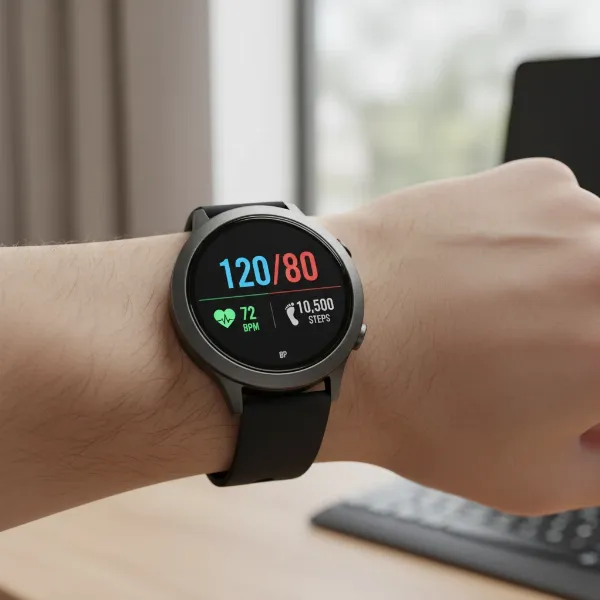
For runners, a smartwatch isn’t just a gadget; it’s a vital training partner, a coach on your wrist, and a precise recorder of every stride. But with countless options flooding the market, how do you choose the one that truly delivers, especially when GPS accuracy is paramount? The difference between a true personal best and a frustratingly inaccurate workout log often comes down to your watch’s ability to precisely track your location, distance, and pace. This guide delves into the world of running smartwatches, highlighting the top contenders where GPS accuracy has been rigorously tested, helping you find the perfect companion for your next run.
Popular Smartwatch Categories for Runners
|
Our Picks for the Best Smartwatch in 2026
As an Amazon Associate I earn from qualifying purchases.
|
||
| Num | Product | Action |
|---|---|---|
| 1 | WHOOP 5.0/MG Activity Tracker - 12 Month Membership - Health and Fitness Wearable – 24/7 Activity and Sleep Tracker, Personalized Coaching, Menstrual Cycle Insights – 14+ Days Battery Life |

|
| 2 | Amazfit Bip 6 Smart Watch 46mm, 14 Day Battery, 1.97" AMOLED Display, GPS & Free Maps, AI, Bluetooth Call & Text, Health, Fitness & Sleep Tracker, 140+ Workout Modes, 5 ATM Water-Resistance, Black |
|
| 3 | SAMSUNG Galaxy Watch 7 40mm Bluetooth AI Smartwatch w/Energy Score, Wellness Tips, Heart Rate Tracking, Sleep Monitor, Fitness Tracker, 2024, Cream [US Version, 1Yr Manufacturer Warranty] |
|
| 4 | Apple Watch Series 11 [GPS 46mm] Smartwatch with Jet Black Aluminum Case with Sport Band - M/L. Sleep Score, Fitness Tracker, Health Monitoring, Always-On Display, Water Resistant |
|
| 5 | Smart Watch, 2026 AMOLED 1.43" Fitness Smartwatch for Men Women, Bluetooth 5.4 Call, 130+Sports Modes, 60+Days Flashlight, Heart Rate/Sleep Monitor, IP68 Waterproof Activity Tracker for Android iOS |
|
| 6 | Smart Watch for Men Women Compatible with iPhone Samsung Android Phone 1.83 inch Full Touch Screen IP68 Waterproof Bluetooh Fitness Tracker Heart Rate/Sleep Monitor, Black |
|
| 7 | Smart Watch for Men, 120+ Sports Modes Smartwatch with 1.83" HD Touchsreen, Sleep Monitor, IP67 Waterproof, Bluetooth Call & Music Control Fitness Watch for iPhone/Android Black |
|
| 8 | Apple Watch Series 11 [GPS 42mm] Smartwatch with Rose Gold Aluminum Case with Light Blush Sport Band - S/M. Sleep Score, Fitness Tracker, Health Monitoring, Always-On Display, Water Resistant |
|
| 9 | Smart Watch with Alexa Built-in, 1.83" HD Touchscreen Fitness Tracker with Bluetooth Calling, Fitness Watch with Heart Rate/Sleep Monitor, 120+ Sports Modes, IP68 Waterproof Smartwatch for Android iOS |
|
| 10 | Smart Watch for Men, 120 Sports Modes Smartwatch with 1.83" HD Touchsreen, IP67 Waterproof, Sleep Monitor, Bluetooth Call & Music Control Fitness Watch for Android/iPhone (Black) |
|
The smartwatch landscape offers a variety of devices, each tailored to different levels of running commitment and lifestyle integration. Understanding these categories helps narrow down your search for the ideal running companion.
Dedicated Running Watches
These smartwatches are purpose-built for athletes, prioritizing advanced running metrics, robust training features, and extended GPS battery life. Brands like Garmin, Coros, and Polar dominate this space, offering intricate data analysis for serious training. They often feature physical buttons for easier control during intense workouts, multi-band GPS for superior accuracy, and specialized recovery tools.
- Pros: Unparalleled GPS accuracy, extensive training data (VO2 Max, training load, recovery, running dynamics), long battery life in GPS mode, durable construction.
- Cons: Can be more expensive, some lack advanced “smart” features found in general smartwatches, designs can be more utilitarian.
- Best for: Marathoners, ultrarunners, triathletes, serious recreational runners, or anyone prioritizing in-depth training analysis.
Fashion-Forward Smartwatches with Running Features
These devices, including models from Apple and Samsung, blend everyday smartwatch functionality with competent running capabilities. They offer sleek designs, vibrant displays, and a strong ecosystem of apps for daily life, alongside solid tracking for various activities. While they may not always match dedicated running watches in specialized metrics or GPS battery life, their versatility is a major draw.
- Pros: Stylish design for everyday wear, excellent display quality, extensive smartwatch features (calls, texts, payments, music), good for general fitness tracking.
- Cons: Shorter GPS battery life compared to dedicated running watches, native running apps may offer less depth, touchscreens can be tricky with wet hands.
- Best for: Casual runners, those who want one watch for all-day wear and fitness tracking, iPhone or Android users who value seamless integration.
Versatile All-Rounder Smartwatches
This category often overlaps with the dedicated running watches but includes models that strike a balance between comprehensive running features and everyday usability. Devices in this segment aim to cater to a broader audience who engage in various sports and also want a capable daily wearable. They typically offer a good mix of accurate GPS, decent battery life, and a range of health and fitness tracking without being overly specialized or excessively bulky.
- Pros: Good balance of features for various activities, respectable GPS accuracy, solid battery life for daily use and runs, often offer integrated health tracking.
- Cons: May not have the absolute longest battery life for extreme ultras, or the deepest niche training metrics.
- Best for: Active individuals who participate in multiple sports, those training for mid-range races (e.g., half-marathons), or runners seeking a capable device without the premium price tag of top-tier dedicated watches.
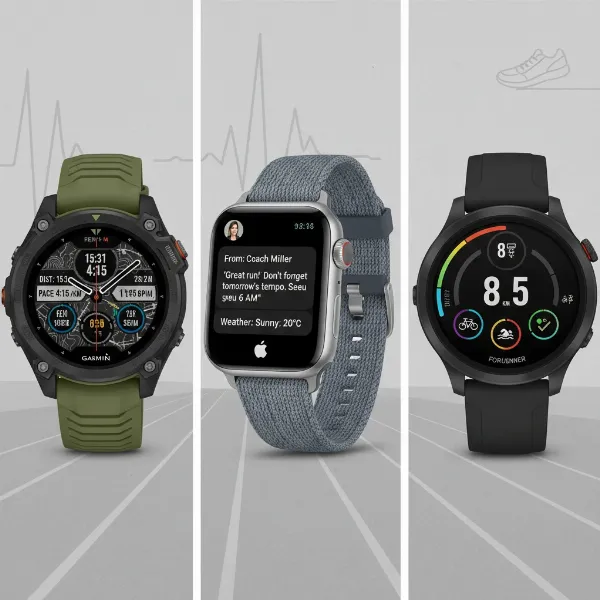 Three smartwatches illustrating dedicated, fashion-forward, and versatile categories for runners.
Top Smartwatch Brands for Running: GPS Accuracy Tested
When it comes to pinpointing your location on a run, some brands consistently rise above the rest. Here’s a comparison of leading smartwatches, with a focus on their GPS performance and features.
Apple Watch
The Apple Watch series, particularly the Ultra models, have significantly improved their running capabilities. The Apple Watch Ultra 3 stands out for its multi-band GPS, delivering excellent accuracy, even in challenging environments like urban areas with tall buildings or under dense tree cover. Its robust build and brightest-ever display make it a reliable choice, though its GPS battery life (up to 14 hours with continuous GPS) still trails behind some dedicated running watches. For iPhone users, the seamless integration with the Apple ecosystem and a vast array of third-party running apps like Strava and Nike Run Club are major advantages.
- Pros: Excellent multi-band GPS accuracy (Ultra 3), vibrant display, robust safety features, extensive app ecosystem, seamless iOS integration.
- Cons: GPS battery life shorter than dedicated running watches, touch-first interface can be difficult with wet hands or gloves, no Android compatibility.
- Price: Premium range.
Samsung Galaxy Watch
For Android users, the Samsung Galaxy Watch Ultra offers a compelling alternative to the Apple Watch Ultra, providing solid GPS accuracy, a durable build, and in-depth sleep and health insights. It features dual-frequency GPS, which enhances precision and offers detailed run-form tracking and advanced running metrics. While generally robust, its battery life (up to 48 hours with GPS) is still typically less than what you might find in a high-end Garmin or Coros device.
- Pros: Solid dual-frequency GPS accuracy, durable construction, excellent AMOLED display, comprehensive health tracking, robust safety features.
- Cons: Shorter battery life compared to many dedicated running watches, can be bulky for some wrists.
- Price: Premium range.
Garmin
Garmin remains a powerhouse in the running watch segment, renowned for its GPS accuracy and deep training analytics.
- Garmin Forerunner 165: Positioned as an excellent overall GPS running watch, it offers accurate built-in GPS and quickly locks onto location (averaging 15-20 seconds). It provides essential running stats and advanced features like training effect.
- Pros: Accurate GPS, lightweight design, bright AMOLED display, comprehensive and customizable training data, good value.
- Cons: GPS lock can take slightly longer than premium models, 19 hours of continuous GPS is solid but not top-tier for ultrarunners.
- Price: Mid-range.
- Garmin Forerunner 965: A premium option featuring multi-band GPS, which Garmin claims is more accurate in “challenging” environments with tall buildings or heavy tree cover. It boasts a noticeably faster GPS acquisition time (5-10 seconds) than the 165.
- Pros: Superior multi-band GPS accuracy, large AMOLED display, extensive specialized workout modes and advanced metrics (training readiness, status), excellent battery life (31 hours in GPS mode).
- Cons: High price.
- Price: High-end premium.
- Garmin Forerunner 970: Often hailed as “best in test” by reviewers, this model integrates Garmin’s latest Elevate Gen 5 optical heart rate sensor and accurate multi-band GPS. It offers Fenix-level features in a more wrist-friendly design, with full-color offline maps and race-day tools.
- Pros: Incredible screen, full-color offline maps, comprehensive training and recovery, accurate multi-band GPS, built-in microphone and speaker.
- Cons: Battery life slightly shorter than some other premium Garmin models in certain GPS modes.
- Price: High-end premium.
- Garmin Enduro 3: Designed for long-haul adventures, the Enduro 3 offers the longest battery life in Garmin’s lineup, with up to 120-320 hours in GPS mode (with solar). It features multi-band GPS for competitive accuracy and robust navigation features.
- Pros: Exceptional battery life for ultrarunners, multi-band GPS, rugged build, excellent mapping and navigation.
- Cons: No AMOLED screen (MIP display), bulky for smaller wrists, high price.
- Price: High-end premium.
“Garmin continues to dominate when it comes to accuracy, training depth, and ecosystem strength. The Forerunner 570 feels like the true sweet spot — bringing the precision and intelligence of Garmin’s fēnix and Epix lines to a lighter, more comfortable watch focused squarely on all runners.” – iRunFar Gear Editor
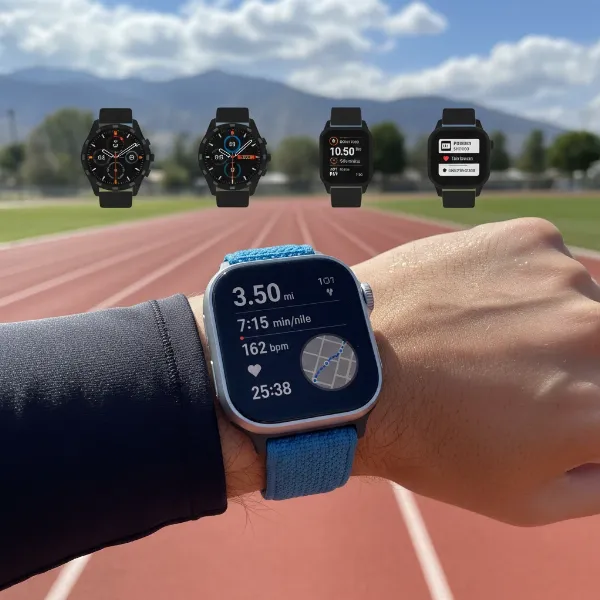 A runner wearing a high-end GPS smartwatch, with other leading models blurred in the background.
Coros
Coros has rapidly gained a reputation for impressive battery life and reliable GPS, particularly among endurance athletes.
- Coros Pace 4: Offers excellent battery life (31 hours in max GPS mode with all satellite systems) and accurate dual-frequency GPS, which maintains stability even in high-rise urban environments.
- Pros: Outstanding battery life, accurate dual-frequency GPS, stunning AMOLED display, comprehensive training features, great value.
- Cons: Lacks full-color offline maps, digital dial can be cumbersome.
- Price: Mid-range.
- Coros Vertix 2S: An upgrade with improved GPS accuracy and a new optical heart rate monitor, though the updates are relatively minor. It’s known for its accuracy in challenging terrains like slot canyons. It boasts exceptional battery life, with up to 118 hours in standard GPS mode.
- Pros: Best-in-class battery life for long adventures, improved GPS accuracy in difficult conditions, rugged sapphire glass and titanium bezel.
- Cons: Bulky for casual wear, higher price, minor upgrades over predecessor.
- Price: High-end premium.
- Coros Apex 4: Features a MIP display for extended battery life (41 hours GPS use) and super-strong sapphire glass for durability. It includes Coros’s multi-band/multi-GNSS chipset, offering precise satellite lock and stable road pacing.
- Pros: Excellent GPS accuracy, great battery life for the price, rugged durability, useful voice integration, improved mapping.
- Cons: MIP display may not appeal to everyone, currently limited color options.
- Price: Mid-range premium.
Suunto
Suunto provides rugged, adventure-ready watches with strong navigation features and competitive GPS accuracy.
- Suunto Race Titanium: Offers good GPS accuracy (all-systems, dual frequency) and a strong battery life of 40-120 hours in GPS mode, though in tests, it drained faster than claimed when using highest accuracy settings.
- Pros: Good dual-frequency GPS accuracy, big AMOLED screen, strong battery life.
- Cons: Optical heart rate performance can be mixed, can be bulky, sluggish raise-to-wake feature.
- Price: Mid-range premium.
- Suunto Run: A beginner-friendly option praised for its exceptional GPS accuracy thanks to a dual-band multi-GNSS chipset. It offers a refreshing minimalistic design and is the lightest watch in many guides.
- Pros: Excellent dual-band GPS accuracy for its price, lightweight and comfortable, bright AMOLED display, simple interface, good build quality.
- Cons: Average battery life compared to more expensive models (20 hours in highest accuracy GPS), slower syncing.
- Price: Entry-level.
- Suunto Vertical 2: Suunto’s top-tier offering, delivering exceptional GPS accuracy and outstanding battery life (nearly 60 hours continuous, full-accuracy GPS, over 200 hours in power-saving modes). It boasts free worldwide maps and a premium design.
- Pros: Exceptional GPS accuracy, outstanding battery life, beautiful design with AMOLED display, free worldwide maps, durable.
- Cons: Bulky and heavy, higher price.
- Price: High-end premium.
Polar
Polar specializes in training-focused watches with strong heart rate monitoring and reliable GPS.
- Polar Pacer Pro: Offers a comprehensive suite of running, training, racing, and recovery features, coupled with all-systems satellite support and super-fast GPS link-up. It has competitive battery life with 35 hours of full GPS run time.
- Pros: Great battery life, rich run tracking features, good value, lightweight, reliable GPS.
- Cons: Basic design, no offline music, limited smartwatch features, no touchscreen.
- Price: Mid-range.
- Polar Grit X2: A return to the competitive market, featuring an accurate dual-band GPS chipset and advanced biosensing. It balances ruggedness with a wearable design and a vibrant AMOLED display.
- Pros: Accurate dual-band GPS, rugged yet compact design, good battery life (30 hours GPS), unique training features.
- Cons: Expensive, lacks offline labeled maps, fewer smartwatch tools.
- Price: High-end premium.
Other Notable Mentions
- Fitbit Charge 6: While more of a fitness tracker, it includes built-in GPS for accurate distance and pace tracking. It’s a budget-friendly option for basic GPS needs but sacrifices advanced features.
- Amazfit T-Rex 3 Pro: Offers excellent value with dual-frequency GPS, impressive battery life (38 hours dual-band GPS), and offline maps at a fraction of the cost of high-end rivals.
Detailed Comparison Table: GPS Running Smartwatches
| Watch Model | GPS Accuracy | GPS Battery Life (Max Accuracy) | Display Type | Key Running Features | Price Range |
|---|---|---|---|---|---|
| Garmin Forerunner 970 | Multi-Band GNSS, Elevate Gen 5 | 21 hours | AMOLED, 1.4″ | Advanced training/recovery, full-color offline maps, ECG, skin temp, running economy, race-day tools. | Premium |
| Garmin Forerunner 965 | Multi-Band GNSS | 31 hours | AMOLED, 1.4″ | Advanced training metrics, training readiness/status, faster GPS lock. | Premium |
| Garmin Forerunner 570 | Multi-band GNSS | 18 hours | AMOLED, 1.4″ | Extensive training/recovery, on-board music, auto-lap, track locking. | Mid-Premium |
| Garmin Forerunner 165 | Built-in GPS | 19 hours | AMOLED, 1.2″ | Basic to intermediate running stats, customizable audio prompts, adaptive training plans. | Mid-Range |
| Garmin Fenix 8 | Multi-Band GPS | 62-145 hours | AMOLED, 1.4″ | Full Garmin suite, Hill Score, Endurance Score, military-grade GPS, offline Spotify. | Premium |
| Garmin Enduro 3 | Multi-Band GPS / Solar | 120-320 hours | MIP, 1.4″ | Ultra-long battery, comprehensive training tools, advanced navigation, trail-adjusted VO2-max. | Premium |
| Apple Watch Ultra 3 | Multi-Band GPS | 14 hours (35 hours low power) | OLED, 1.9″ Retina | Advanced health/activity monitoring, crash detection, fall detection, emergency satellite connectivity, vast app ecosystem. | Premium |
| Samsung Galaxy Watch Ultra | Dual-Frequency GPS | 48 hours | AMOLED, 1.5″ | Run-form tracking, advanced running metrics (asymmetry, ground contact time), safety siren, deep health insights. | Premium |
| Coros Vertix 2S | All-5 Satellite Systems | 118 hours | MIP, 1.4″ | Best GPS in challenging terrain, enhanced optical HR, sapphire glass, titanium bezel, multi-day expeditions. | Premium |
| Coros Pace 4 | Dual-Frequency GPS | 31 hours | AMOLED, 1.2″ | Evo Lab training tools, running performance, training load, recovery, voice integration, in-app route planning. | Mid-Range |
| Coros Apex 4 | Multi-band GNSS | 41 hours | MIP, 1.2″ | Reliable GPS, excellent mapping, voice alerts, action button, rugged durability. | Mid-Premium |
| Suunto Race Titanium | All-Systems, Dual-Frequency GPS | 40-120 hours | AMOLED, 1.43″ | AI coaching, race pacing, training load, progress, recovery, heat-map route planning. | Mid-Premium |
| Suunto Run | Dual-Band Multi-GNSS | 20 hours | AMOLED, 1.32″ | Entry-level essentials, reliable HR, basic recovery, structured intervals, simple interface, lightweight. | Entry-Level |
| Suunto Vertical 2 | Multi-band GNSS | 65 hours (200+ eco mode) | AMOLED, 1.5″ | Exceptional GPS, outstanding battery, free worldwide maps, built-in flashlight, premium design. | Premium |
| Polar Pacer Pro | All-Systems Satellite Support | 35 hours | MIP, 1.2″ | Comprehensive training/recovery, running performance test, VO2 Max, race time predictor, turn-by-turn navigation. | Mid-Range |
| Polar Grit X2 | Dual-Band GPS | 30 hours | AMOLED, 1.28″ | Rugged, Hill Splitter, Fuelwise, excellent nightly sleep/recovery tools, Komoot/Strava route import. | Premium |
| Amazfit T-Rex 3 Pro | Dual-Frequency GPS | 38 hours | AMOLED, 1.5″ | Great value, 177 sports modes, AI coaching, training readiness, recovery, offline maps. | Mid-Range |
| Fitbit Charge 6 | Built-in GPS | 7 days (smartwatch mode) | AMOLED, 1.4″ | Basic distance/pace, 20 exercise modes, Bluetooth pairing with gym equipment. | Entry-Level |
How to Choose the Right Smartwatch for Your Runs
Selecting the perfect GPS running smartwatch involves more than just picking the trendiest model. It’s about matching the watch’s capabilities to your unique running style, goals, and lifestyle.
1. Determine Your Usage Needs
Consider your primary running activities. Are you a casual jogger, a dedicated marathoner, an ultrarunner tackling multi-day expeditions, or a trail runner navigating complex terrains?
- Casual Runners: May prioritize comfort, basic GPS, and general health tracking. A Garmin Forerunner 165 or Suunto Run could be ideal.
- Marathoners/Half-Marathoners: Need accurate pace and distance, reliable heart rate, and battery life to cover several hours of GPS tracking. Many Garmin Forerunner models or the Coros Pace 4 fit this bill.
- Ultrarunners/Adventurers: Demand exceptional GPS accuracy in challenging environments, long-lasting battery life (40+ hours in GPS mode), robust navigation, and durability. The Garmin Enduro 3, Coros Vertix 2S, or Suunto Vertical 2 are strong contenders.
2. Set Your Budget
Smartwatches for running range widely in price. Entry-level models provide essential tracking, while premium devices offer advanced features, superior materials, and often better GPS performance.
- Entry-level (Under $200): Focus on basic GPS, heart rate, and activity tracking (e.g., Fitbit Charge 6, Amazfit Active 2).
- Mid-range ($200-$500): Offers a good balance of features, including accurate dual-frequency GPS and enhanced training metrics (e.g., Garmin Forerunner 165, Coros Pace 4, Suunto Run, Polar Pacer Pro).
- Premium ($500+): Provides top-tier GPS accuracy (multi-band), advanced analytics, robust build quality, and comprehensive smartwatch integration (e.g., Garmin Forerunner 970/965, Fenix 8, Apple Watch Ultra 3, Coros Vertix 2S, Suunto Vertical 2).
3. Prioritize GPS Technology
For runners, GPS accuracy is paramount. Look for watches with:
- Multi-band/Dual-frequency GPS: This technology utilizes multiple satellite frequencies, significantly improving accuracy in difficult conditions like urban canyons, dense forests, or mountainous terrain. Many top-tier Garmin, Coros, Suunto, Apple Watch, and Polar models now offer this.
- Fast GPS Lock: How quickly the watch acquires a satellite signal before you start your run. Garmin Forerunner 965 and Apple Watch Ultra 3 are noted for quick acquisition.
4. Assess Battery Life
Consider both “smartwatch mode” and “GPS mode” battery life. For long runs or multi-day events, a watch with 30+ hours of continuous GPS tracking is often preferred. Ultrarunners might need 60+ hours, as offered by models like the Garmin Enduro 3 or Coros Vertix 2S.
5. Evaluate Comfort and Fit
A watch’s size, weight, and strap material can significantly impact comfort, especially on long runs. Watches like the Suunto Run are praised for their lightweight design and comfortable straps. Some brands offer different sizes to accommodate smaller wrists.
6. Consider Ecosystem and Smart Features
Are you an iPhone or Android user? Do you want to receive notifications, make contactless payments, or store music directly on your watch? Apple Watch Ultra 3 and Samsung Galaxy Watch Ultra offer excellent smartwatch integration, while Garmin and Coros focus more on running-specific features but also include essential smart capabilities.
7. Look for Advanced Running Metrics
Beyond distance and pace, serious runners benefit from metrics like:
- Heart Rate Variability (HRV): For recovery and readiness.
- Running Dynamics: Cadence, stride length, ground contact time, vertical oscillation.
- Training Load and Effect: To optimize workouts and prevent overtraining.
- VO2 Max Estimation: For fitness level assessment.
- Offline Maps and Navigation: Crucial for trail running and exploring new routes.
Conclusion
Choosing the best smartwatch for running, especially when prioritizing GPS accuracy, requires careful consideration of various factors, from your specific running needs to your budget and preferred ecosystem. While dedicated running watches from Garmin, Coros, Suunto, and Polar often lead the pack in precise GPS tracking, extensive training features, and superior battery life, smartwatches like the Apple Watch Ultra 3 and Samsung Galaxy Watch Ultra offer a compelling blend of daily functionality and capable running performance with increasingly accurate GPS. Ultimately, the “best” watch is the one that empowers you to hit your running goals with confidence, knowing every mile and every minute is tracked with unwavering precision.
What features do you value most in a GPS running smartwatch, and how has GPS accuracy impacted your training?
Frequently Asked Questions
Which running watch has the best GPS accuracy?
Many top-tier running watches now feature multi-band or dual-frequency GPS, which significantly enhances accuracy. Models like the Garmin Forerunner 970/965, Coros Vertix 2S, Suunto Vertical 2, Apple Watch Ultra 3, and Polar Grit X2 are consistently rated for their exceptional GPS precision, especially in challenging environments where signals can be obstructed. The Coros Vertix 2S is particularly noted for outperforming others in difficult conditions like slot canyons or under heavy tree cover.
What’s the difference between a fitness tracker with GPS and a dedicated running watch?
While fitness trackers like the Fitbit Charge 6 offer built-in GPS for basic tracking, dedicated running watches (e.g., Garmin Forerunner series, Coros Pace) provide a much deeper dive into running-specific metrics, advanced training analysis, longer GPS battery life, and more robust navigation features. Fitness trackers often rely more on a connected smartphone for advanced features, whereas running watches are standalone powerhouses for athletes.
How does multi-band/dual-frequency GPS improve accuracy?
Multi-band (or dual-frequency) GPS receivers can pick up signals from satellites on multiple frequency bands (L1 and L5). This capability allows the watch to filter out reflected signals (common in urban areas or dense forests) and environmental interference more effectively, leading to significantly more precise location tracking, distance measurement, and real-time pace data.
How long should a running watch’s battery last in GPS mode?
For most recreational runners, 10-15 hours of continuous GPS battery life is sufficient for daily runs and shorter races. For marathoners, 20-30 hours is preferable. Ultrarunners, however, often require 40 hours or more, with some watches like the Garmin Enduro 3 and Coros Vertix 2S offering well over 100 hours in optimized GPS modes to support multi-day events.
Can I use a GPS running watch for other activities?
Yes, most GPS running smartwatches are multi-sport devices, capable of tracking a wide range of activities beyond running, such as cycling, swimming, hiking, strength training, and more. They often come with dedicated profiles and metrics for each sport, making them versatile tools for active individuals.