In an increasingly digital world, your health data is more exposed than ever before. From the smartwatches on our wrists tracking every heartbeat to telehealth platforms connecting us with doctors remotely, personal health information (PHI) is continuously collected, stored, and shared. While these advancements offer incredible benefits for personal wellness and healthcare efficiency, they also present significant privacy challenges. Understanding how to safeguard this incredibly sensitive information is not just a technical task; it’s a fundamental aspect of maintaining control over your personal life. This comprehensive guide will walk you through the landscape of digital health data, highlight the threats, and provide actionable strategies to secure your most personal information.
Understanding Your Digital Health Data Footprint
Your health data encompasses a wide range of sensitive information, from medical records and diagnoses to lifestyle metrics. In the digital age, this “Protected Health Information” (PHI) can be generated in countless ways:
- Wearable Devices: Smartwatches, fitness trackers, and smart rings collect biometric data like heart rate, sleep patterns, activity levels, and even location.
- Health Apps: Applications on your smartphone can track diet, exercise, fertility, mental health, and medication adherence.
- Telehealth Platforms: Virtual doctor visits and online portals create digital records of consultations, prescriptions, and health summaries.
- Electronic Health Records (EHRs): These are comprehensive digital versions of your medical chart maintained by healthcare providers.
Each interaction with these technologies contributes to a growing digital footprint of your health, making proactive privacy measures essential.
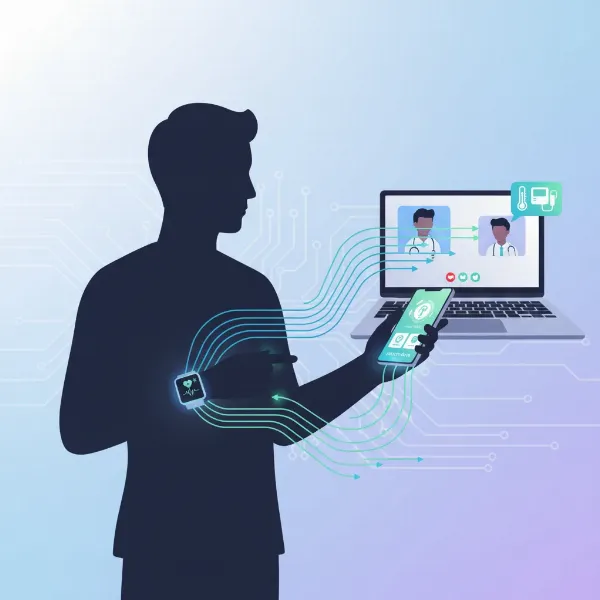 Illustration of various devices contributing to an individual's digital health data footprint and profile.
The Regulatory Landscape: What’s Protected (and What Isn’t)
Navigating the world of health data privacy requires understanding the regulations designed to protect you, as well as their limitations.
HIPAA in the United States
|
Our Picks for the Best Smartwatch in 2026
As an Amazon Associate I earn from qualifying purchases.
|
||
| Num | Product | Action |
|---|---|---|
| 1 | Amazfit Bip 6 Smart Watch 46mm, 14 Day Battery, 1.97" AMOLED Display, GPS & Free Maps, AI, Bluetooth Call & Text, Health, Fitness & Sleep Tracker, 140+ Workout Modes, 5 ATM Water-Resistance, Black |

|
| 2 | Smart Watch for Men, 120 Sports Modes Smartwatch with 1.83" HD Touchsreen, IP67 Waterproof, Sleep Monitor, Bluetooth Call & Music Control Fitness Watch for Android/iPhone (Black) |
|
| 3 | Smart Watch for Men, 120+ Sports Modes Smartwatch with 1.83" HD Touchsreen, Sleep Monitor, IP67 Waterproof, Bluetooth Call & Music Control Fitness Watch for iPhone/Android Black |
|
| 4 | Apple Watch Series 11 [GPS 42mm] Smartwatch with Rose Gold Aluminum Case with Light Blush Sport Band - S/M. Sleep Score, Fitness Tracker, Health Monitoring, Always-On Display, Water Resistant |
|
| 5 | Apple Watch Series 11 [GPS 46mm] Smartwatch with Jet Black Aluminum Case with Sport Band - M/L. Sleep Score, Fitness Tracker, Health Monitoring, Always-On Display, Water Resistant |
|
| 6 | WHOOP 5.0/MG Activity Tracker - 12 Month Membership - Health and Fitness Wearable – 24/7 Activity and Sleep Tracker, Personalized Coaching, Menstrual Cycle Insights – 14+ Days Battery Life |
|
| 7 | SAMSUNG Galaxy Watch 7 40mm Bluetooth AI Smartwatch w/Energy Score, Wellness Tips, Heart Rate Tracking, Sleep Monitor, Fitness Tracker, 2024, Cream [US Version, 1Yr Manufacturer Warranty] |
|
| 8 | Smart Watch, 2026 AMOLED 1.43" Fitness Smartwatch for Men Women, Bluetooth 5.4 Call, 130+Sports Modes, 60+Days Flashlight, Heart Rate/Sleep Monitor, IP68 Waterproof Activity Tracker for Android iOS |
|
| 9 | Smart Watch with Alexa Built-in, 1.83" HD Touchscreen Fitness Tracker with Bluetooth Calling, Fitness Watch with Heart Rate/Sleep Monitor, 120+ Sports Modes, IP68 Waterproof Smartwatch for Android iOS |
|
| 10 | Smart Watch for Men Women Compatible with iPhone Samsung Android Phone 1.83 inch Full Touch Screen IP68 Waterproof Bluetooh Fitness Tracker Heart Rate/Sleep Monitor, Black |
|
The Health Insurance Portability and Accountability Act (HIPAA) is a federal law that sets national standards for protecting sensitive patient health information. It applies primarily to “covered entities”—healthcare providers, health plans, and healthcare clearinghouses—and their “business associates” (third-party vendors who handle PHI on their behalf). HIPAA’s Privacy Rule governs the use and disclosure of PHI, while its Security Rule mandates safeguards for electronic PHI (ePHI).
However, a crucial distinction exists: HIPAA generally does not cover data collected by many direct-to-consumer health apps, websites, or personal wearable devices, unless that technology is provided by or directly affiliated with a HIPAA-covered entity. This “HIPAA Gap” means that much of the health data generated by your personal devices and apps may not be afforded the same level of legal protection, leaving it vulnerable to sharing or sale without your explicit, easily understood consent. As consumer expert Kevin Brasler noted, “A big problem is that recently, the [Federal Trade Commission] sued and fined several large apps for not doing what they promised. For not keeping their customers’ private medical information private. They were sharing that data with others and largely without their own customers’ consent.” This highlights the importance of individual vigilance.
Global Regulations (Briefly)
While HIPAA focuses on the US, other regions have their own robust data protection laws. The General Data Protection Regulation (GDPR) in Europe, for instance, sets strict standards for how personal data (including health data) of EU citizens must be collected, stored, and processed, regardless of where the company operating the service is located. These regulations often empower individuals with more control over their data.
Common Threats to Your Digital Health Information
Protecting your health data begins with understanding the pervasive threats it faces:
- Data Breaches and Cyberattacks: Healthcare organizations are prime targets for cybercriminals. Breaches can expose vast amounts of PHI through hacking, ransomware, or insider threats, leading to identity theft or financial fraud.
- Unauthorized Third-Party Sharing: Many consumer health apps and wearable devices operate outside HIPAA’s purview. Their business models often involve sharing or selling aggregated or even identifiable health data to advertisers, data brokers, and other companies. This can result in targeted advertising based on your health conditions or even discrimination.
- Weak Personal Security Habits: Using simple passwords, reusing credentials across multiple services, and neglecting software updates create easy entry points for malicious actors.
- Lost or Stolen Devices: An unprotected smartphone, tablet, or laptop containing health apps or access to patient portals can expose your entire health history if it falls into the wrong hands.
- Phishing and Social Engineering: Cybercriminals often use deceptive emails, texts, or calls to trick individuals into revealing login credentials or downloading malware, which can then compromise health data.
Essential Strategies for Securing Your Health Data
Taking control of your health data privacy requires a multi-layered approach and consistent effort. Here are crucial strategies you can implement:
Strong Authentication is Non-Negotiable
The first line of defense for any digital account is your login credentials.
- Unique, Complex Passwords: Create long, complex passwords that combine uppercase and lowercase letters, numbers, and symbols. Crucially, use a unique password for every health-related app, portal, and device. A password manager can help you manage these securely.
- Multi-Factor Authentication (MFA): Enable MFA (also known as two-factor authentication or 2FA) on all health-related accounts, including patient portals, health apps, and even email accounts linked to health services. This adds an extra layer of security, typically requiring a code from your phone or a biometric scan in addition to your password.
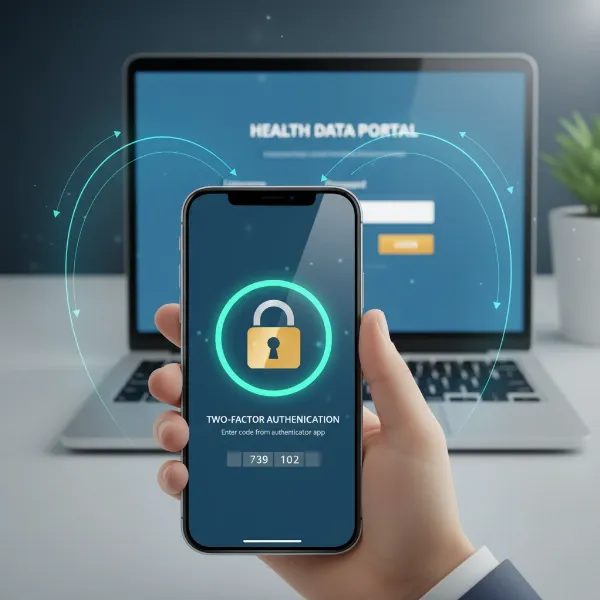 Visual representation of multi-factor authentication securing digital health data with a phone and password.
Encrypt Your Devices and Data
Encryption scrambles your information, making it unreadable to anyone without the correct key.
- Enable Device Encryption: Ensure full-disk encryption is enabled on your smartphone, tablet, and laptop. Most modern operating systems offer this feature.
- Choose Encrypted Apps and Services: Opt for health apps, messaging services, and cloud storage providers that offer end-to-end encryption for your data, both when it’s stored (“at rest”) and when it’s being transmitted (“in transit”).
Master Your Privacy Settings and App Permissions
Many apps and devices collect more data than necessary by default.
- Regularly Review App Permissions: On your smartphone and tablet, periodically check and revoke permissions for health apps that access your camera, microphone, location, contacts, or photos if they don’t genuinely need them for their core function.
- Customize Privacy Settings: Dive into the settings of your health apps, wearables, and online patient portals. Limit data collection to essential functions and opt-out of sharing data for marketing or research purposes whenever possible.
- Understand Privacy Policies: While often lengthy, try to review the privacy policies of health apps and wearable devices to understand exactly what data they collect, how it’s used, and with whom it’s shared. Look for clear language regarding data ownership and deletion rights.
Be Smart About Wearables and Fitness Trackers
Wearable technology offers immense health benefits, but its data collection practices warrant extra scrutiny.
- Read Before You Buy: Before purchasing a smartwatch or fitness tracker, research the manufacturer’s privacy reputation and data handling policies.
- Disable Unnecessary Features: Many wearables have features like location tracking, microphone access, or automatic data syncing that you might not need or want enabled 24/7. Turn off features you don’t use to minimize data collection.
- Control Data Syncing: Limit which third-party apps can access data from your wearable. For example, you might not want your fitness tracker data automatically shared with a social media app.
Secure Your Network and Connections
The way you access your health data can also create vulnerabilities.
- Avoid Public Wi-Fi for Sensitive Data: Never access patient portals, telehealth services, or sensitive health apps over unsecured public Wi-Fi networks. These networks are often vulnerable to eavesdropping.
- Use a Virtual Private Network (VPN): A VPN encrypts your internet connection, providing a secure tunnel for your data, especially when you’re using Wi-Fi outside your home.
Practice Consistent Digital Hygiene
Good digital habits are foundational to robust privacy.
- Keep Software Updated: Regularly update your operating systems, apps, and device firmware. Updates often include critical security patches that fix vulnerabilities.
- Securely Dispose of Old Devices: Before selling, donating, or recycling old smartphones, smartwatches, or computers, perform a factory reset and securely wipe all data to prevent recovery.
- Regular Backups: Back up important health data (if permissible and secure) to an encrypted external drive or a HIPAA-compliant cloud service.
Beware of Phishing and Scams
You are often the weakest link in your security chain.
- Verify Sources: Be suspicious of unsolicited emails, texts, or calls asking for personal or health information. Always verify the sender’s identity before clicking links or providing data.
- Think Before You Click: Malicious links can lead to websites designed to steal your credentials or install malware. If in doubt, navigate directly to the official website instead.
Taking Control: Your Rights and Actions
Empowering yourself with knowledge and action is key to protecting your health data.
- Exercise Your Rights: Under HIPAA, you have the right to access your medical records, request corrections, and get an accounting of disclosures. For consumer apps, look for similar rights in their privacy policies regarding data access and deletion.
- Report Concerns: If you suspect a data breach or improper handling of your PHI by a HIPAA-covered entity, report it to the U.S. Department of Health and Human Services (HHS) Office for Civil Rights. For consumer apps, you might report concerns to the Federal Trade Commission (FTC).
- Advocate for Stronger Protections: Support initiatives and legislation that aim to extend data privacy protections to consumer-generated health data, closing the “HIPAA Gap.”
Conclusion
Securing your health data is an ongoing responsibility that demands vigilance and proactive measures. In a world where every step, heartbeat, and health query contributes to your digital profile, understanding the risks and implementing robust security practices is paramount. From enabling strong authentication to meticulously reviewing app permissions and encrypting your devices, every action you take contributes to a stronger defense. By staying informed, making conscious choices about the technology you use, and actively managing your digital footprint, you can ensure your most personal information remains private.
What steps will you take today to fortify the privacy of your health data?
Frequently Asked Questions
Is my fitness tracker data protected by HIPAA?
Generally, no. HIPAA primarily covers healthcare providers, health plans, and their business associates. Unless your fitness tracker or health app is directly provided by or integrated with a HIPAA-covered entity, the data it collects is typically not protected by HIPAA and can be shared with third parties.
How can I find out if a health app shares my data?
The best way is to carefully read the app’s privacy policy and terms of service. Look for sections detailing “data sharing,” “third parties,” “marketing,” or “analytics.” If the policy is unclear or difficult to understand, consider choosing an alternative app that is more transparent.
What are the most important settings to check on my smartwatch for privacy?
Focus on disabling unnecessary permissions like location tracking (if not needed), microphone access, and automatic data syncing with third-party apps. Also, ensure your smartwatch has a strong passcode or biometric lock, and that its firmware is always up to date.