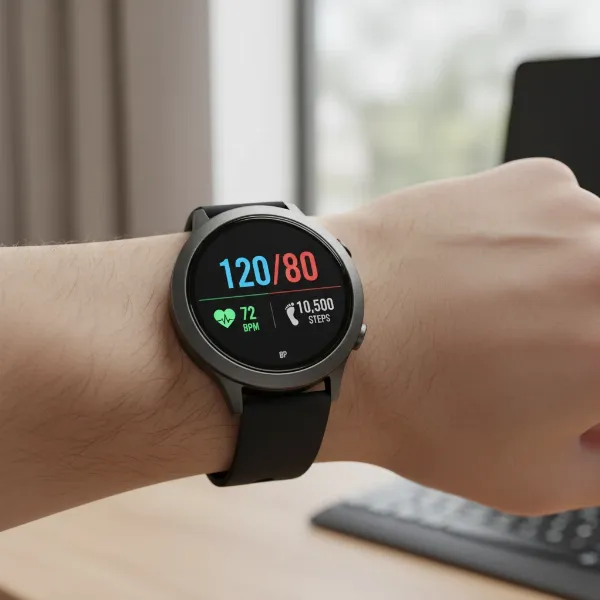
In an age where personal health data is increasingly accessible, wearable technology has revolutionized how we monitor our well-being, with sleep tracking standing out as a critical feature. From understanding sleep duration to discerning intricate sleep stages, these devices promise a window into our nightly rest. However, with numerous options on the market, a crucial question arises: how accurate are they? This article delves into the sleep tracking capabilities of three leading wearables – Fitbit, Apple Watch, and Oura Ring – comparing their performance, features, and overall reliability against the scientific gold standard, polysomnography (PSG).
Understanding Sleep Tracking in Wearables
Wearable sleep trackers utilize a combination of sophisticated sensors to estimate your sleep patterns and stages. Accelerometers detect movement, optical heart rate sensors monitor heart rate and heart rate variability (HRV), and some devices incorporate skin temperature sensors. By analyzing these physiological signals, algorithms attempt to differentiate between wakefulness, light sleep, deep sleep, and Rapid Eye Movement (REM) sleep. While impressive, it’s vital to remember that these consumer devices infer sleep stages, unlike polysomnography (PSG), which directly measures brainwaves (EEG), eye movements, and muscle activity in a clinical setting, providing the most accurate and detailed sleep analysis.
The Contenders: Fitbit, Apple Watch, and Oura Ring
Each of these devices approaches sleep tracking with its unique strengths, catering to different user priorities. Fitbit, a pioneer in fitness tracking, offers comprehensive sleep data integrated into a broader wellness ecosystem. The Apple Watch leverages its powerful hardware and seamless integration within the Apple ecosystem to provide health insights. The Oura Ring, a less conspicuous wearable, focuses heavily on in-depth sleep and recovery metrics.
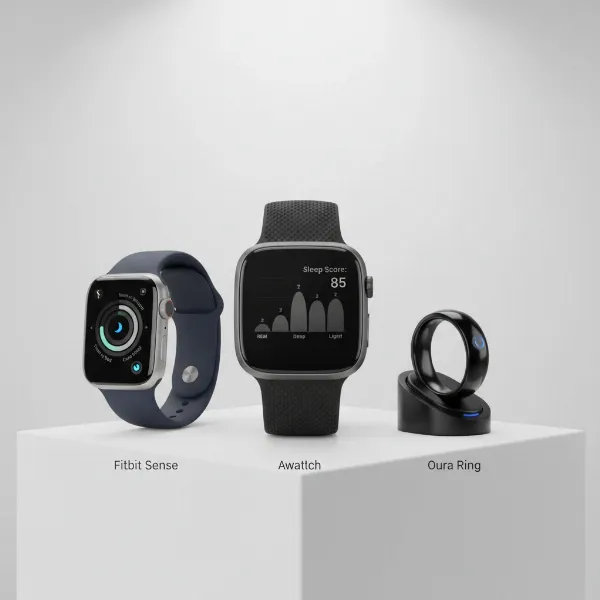 Three popular wearable sleep trackers: Fitbit, Apple Watch, Oura Ring, showcased together.
Fitbit Sleep Tracking Accuracy
Fitbit devices are widely recognized for their user-friendly approach to sleep tracking and comprehensive daily health insights. They generally excel at detecting when you fall asleep and wake up, offering high sensitivity for overall sleep detection. Studies indicate Fitbit devices achieve approximately 95% sensitivity in distinguishing sleep from wakefulness.
Pros:
- Reliable Sleep/Wake Detection: Fitbit consistently demonstrates high accuracy in identifying total time spent asleep.
- Detailed Sleep Insights: Users receive a comprehensive sleep score and a breakdown of sleep stages, including light, deep, and REM sleep, along with useful metrics like sleep schedule variability and the time it takes to reach sound sleep.
- SpO2 Variation: Newer Fitbit models can track variations in arterial oxygen saturation (SpO2) during sleep, which may indicate potential breathing disturbances.
- Good for Trends: For monitoring long-term sleep patterns and identifying habits, Fitbit’s data provides valuable insights.
Cons:
- Sleep Stage Precision: Compared to PSG, Fitbit can be less precise in classifying individual sleep stages. Research suggests it may underestimate light sleep while overestimating deep and REM sleep duration. Deep sleep sensitivity has been reported between 27.9% and 59% in various studies.
- Not a Diagnostic Tool: While SpO2 variation can hint at issues like sleep apnea, Fitbit is not approved by regulatory authorities for diagnosing sleep disorders.
|
Our Picks for the Best Smartwatch in 2026
As an Amazon Associate I earn from qualifying purchases.
|
||
| Num | Product | Action |
|---|---|---|
| 1 | Apple Watch Series 11 [GPS 46mm] Smartwatch with Jet Black Aluminum Case with Sport Band - M/L. Sleep Score, Fitness Tracker, Health Monitoring, Always-On Display, Water Resistant |
![Check Apple Watch Series 11 [GPS 46mm] Smartwatch with Jet Black Aluminum Case with Sport Band - M/L. Sleep Score, Fitness Tracker, Health Monitoring, Always-On Display, Water Resistant on Amazon](https://smartwatchus.com/wp-content/plugins/amazon-tables/assets/images/buy.png)
|
| 2 | Smart Watch, 2026 AMOLED 1.43" Fitness Smartwatch for Men Women, Bluetooth 5.4 Call, 130+Sports Modes, 60+Days Flashlight, Heart Rate/Sleep Monitor, IP68 Waterproof Activity Tracker for Android iOS |
|
| 3 | WHOOP 5.0/MG Activity Tracker - 12 Month Membership - Health and Fitness Wearable – 24/7 Activity and Sleep Tracker, Personalized Coaching, Menstrual Cycle Insights – 14+ Days Battery Life |
|
| 4 | Amazfit Bip 6 Smart Watch 46mm, 14 Day Battery, 1.97" AMOLED Display, GPS & Free Maps, AI, Bluetooth Call & Text, Health, Fitness & Sleep Tracker, 140+ Workout Modes, 5 ATM Water-Resistance, Black |
|
| 5 | Smart Watch for Men, 120+ Sports Modes Smartwatch with 1.83" HD Touchsreen, Sleep Monitor, IP67 Waterproof, Bluetooth Call & Music Control Fitness Watch for iPhone/Android Black |
|
| 6 | Smart Watch for Men, 120 Sports Modes Smartwatch with 1.83" HD Touchsreen, IP67 Waterproof, Sleep Monitor, Bluetooth Call & Music Control Fitness Watch for Android/iPhone (Black) |
|
| 7 | SAMSUNG Galaxy Watch 7 40mm Bluetooth AI Smartwatch w/Energy Score, Wellness Tips, Heart Rate Tracking, Sleep Monitor, Fitness Tracker, 2024, Cream [US Version, 1Yr Manufacturer Warranty] |
|
| 8 | Smart Watch with Alexa Built-in, 1.83" HD Touchscreen Fitness Tracker with Bluetooth Calling, Fitness Watch with Heart Rate/Sleep Monitor, 120+ Sports Modes, IP68 Waterproof Smartwatch for Android iOS |
|
| 9 | Smart Watch for Men Women Compatible with iPhone Samsung Android Phone 1.83 inch Full Touch Screen IP68 Waterproof Bluetooh Fitness Tracker Heart Rate/Sleep Monitor, Black |
|
| 10 | Apple Watch Series 11 [GPS 42mm] Smartwatch with Rose Gold Aluminum Case with Light Blush Sport Band - S/M. Sleep Score, Fitness Tracker, Health Monitoring, Always-On Display, Water Resistant |
|
Overall: Fitbit remains a strong, accessible option for individuals seeking consistent and detailed general sleep tracking and trend analysis within a broader wellness platform.
Apple Watch Sleep Tracking Accuracy
The Apple Watch, a powerhouse of wearable technology, integrates sleep tracking seamlessly into the vast Apple Health ecosystem. It utilizes its advanced sensors to provide users with insights into their sleep architecture. The Apple Watch demonstrates very high sensitivity for detecting sleep periods.
Pros:
- High Sleep Detection Sensitivity: The Apple Watch boasts impressive 97% sensitivity in detecting sleep episodes.
- Robust Health Ecosystem Integration: Sleep data integrates deeply with Apple Health, correlating with other metrics like heart rate and respiratory rate.
- Accurate Heart Rate Tracking: The Apple Watch is renowned for its highly accurate heart rate monitoring, both at rest and during activity, which contributes to sleep stage estimation.
- Wrist Temperature Tracking: Newer models offer wrist temperature tracking, providing additional data points for sleep and cycle tracking.
Cons:
- Sleep Stage Accuracy Varies: While effective, the Apple Watch can sometimes overestimate light and deep sleep stages. One study indicated approximately 62% accuracy in detecting deep sleep, often confusing it with core sleep. In another study, Apple Watch had a 50.5% sensitivity for deep sleep detection and a 52.4% sensitivity for wake detection, which was lower than Oura and Fitbit in that particular comparison.
- Inconsistent User Experience: Some users have reported inconsistencies, such as the device not tracking sleep intervals under four hours or issues with capturing sleep after waking up and going back to bed, sometimes requiring manual Sleep Focus activation.
- Data Interpretation: While providing ample raw data, the Apple Health app sometimes offers less interpreted analysis compared to dedicated sleep platforms.
Overall: The Apple Watch is an excellent choice for users embedded in the Apple ecosystem who desire good general sleep tracking alongside a comprehensive suite of other health and fitness features. Its accuracy for sleep stages is solid for a wrist-worn device, though individual results can vary.
Oura Ring Sleep Tracking Accuracy
The Oura Ring distinguishes itself with a focus on advanced sleep and recovery metrics, packed into a discreet and comfortable ring form factor. Recent independent studies highlight the Oura Ring’s strong performance in sleep tracking accuracy.
Pros:
- Leading Sleep Stage Accuracy: The Oura Ring consistently demonstrates the highest overall accuracy and sensitivity in four-stage sleep classification when compared to Apple Watch and Fitbit in recent peer-reviewed studies. It was found to be 5% more accurate than the Apple Watch and 10% more accurate than Fitbit.
- Superior Wake & Deep Sleep Detection: Oura Ring exhibits the highest sensitivity for both wake detection (68.6%) and deep sleep detection (79.5%) among the three, and it does not significantly over- or underestimate any sleep stages.
- Advanced Metrics: Beyond basic sleep stages, Oura provides a comprehensive “Readiness Score,” nap detection, and highly accurate measurements of resting heart rate, heart rate variability (HRV), and body temperature, crucial indicators for recovery and overall well-being.
- Comfort & Battery Life: Its ring form factor is often more comfortable for sleep than wrist-worn devices, and it boasts a multi-day battery life (typically 4-7 days), minimizing charging interruptions.
Cons:
- Higher Price Point: The Oura Ring is generally the most expensive option among the three.
- Limited Real-Time Activity Tracking: While excellent for passive monitoring, it’s not designed for real-time workout tracking in the same way smartwatches are.
Overall: For individuals prioritizing highly accurate sleep stage data, comprehensive recovery insights, and a discreet form factor, the Oura Ring stands out as a leading choice, especially with improvements in its latest generations.
Comparative Analysis: Fitbit vs. Apple Watch vs. Oura Ring
When choosing a sleep tracker, understanding the nuances of each device’s capabilities is key. Here’s a detailed comparison:
| Feature / Device | Fitbit | Apple Watch | Oura Ring |
|---|---|---|---|
| Overall Sleep Detection | High (95% sensitivity) | Very High (97% sensitivity) | High (95% sensitivity) |
| Sleep Stage Accuracy (vs. PSG) | Lower; tends to over/underestimate stages. Deep sleep sensitivity: 27.9%-59%. | Moderate; can overestimate deep/light sleep. Deep sleep sensitivity: 50.5-62%. | Highest overall accuracy. Deep sleep sensitivity: 79.5%. No significant over/underestimation. |
| Wake Detection | Good (67.7% sensitivity) | Moderate (52.4% sensitivity) | Highest (68.6% sensitivity) |
| Other Key Metrics | SpO2 variation, Sleep Score, Sleep Profile. | Heart Rate (very accurate), Respiratory Rate, Wrist Temperature. | Resting HR, HRV, Body Temperature, Readiness Score, Nap Detection, SpO2. |
| Comfort/Form Factor | Wrist-worn smartwatch/tracker. | Wrist-worn smartwatch. | Ring (discreet, comfortable for sleep). |
| Battery Life | Varies by model, generally good (multiple days for trackers). | Typically 1-2 days, often charged daily. | Multiple days (e.g., 4-7 days for Gen3/4). |
| Price | Mid-range. | High-end. | High-end. |
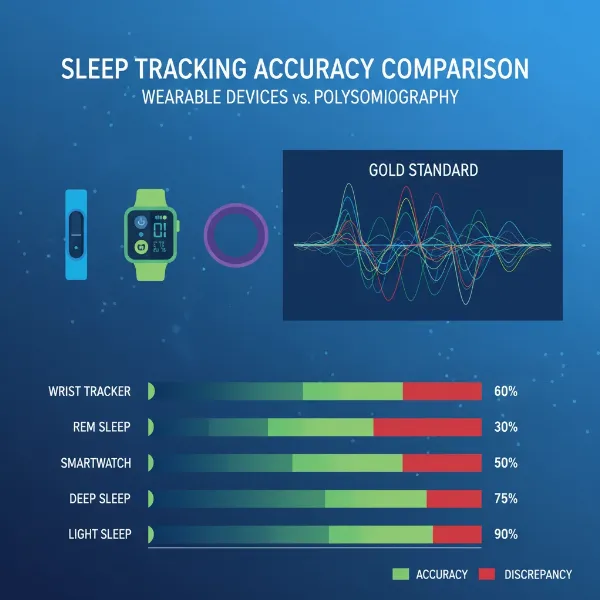 Visual representation of sleep data comparison from different wearable devices vs. PSG.
Choosing the Right Sleep Tracker for You
Selecting the ideal sleep tracker depends on your individual needs, lifestyle, and priorities. Consider the following factors:
Determine Your Usage Needs
- Basic Sleep Tracking & Trends: If your primary goal is to understand overall sleep duration, consistency, and general trends, Fitbit offers a user-friendly and comprehensive solution.
- Comprehensive Health Ecosystem: For those deeply integrated into the Apple ecosystem, the Apple Watch provides robust general sleep tracking alongside extensive fitness and health monitoring capabilities.
- Medical-Grade Accuracy & Deep Insights: If you prioritize the most accurate sleep stage data and detailed physiological insights for recovery and readiness, the Oura Ring is likely your best bet.
Budget
Your budget will play a significant role. Fitbit devices often come at a more accessible price point, while the Oura Ring and Apple Watch are positioned as premium, higher-end devices.
Comfort and Lifestyle
Consider the device’s form factor. Wrist-worn devices like Fitbit and Apple Watch are versatile but might feel intrusive for some during sleep. The Oura Ring offers a discreet and comfortable alternative, especially for those who prefer not to wear a watch to bed.
Other Features
Evaluate what other metrics are important to you. Do you need highly accurate heart rate monitoring during workouts? Is SpO2 tracking a priority? Do you value detailed recovery scores or nap detection? Each device offers unique strengths beyond basic sleep tracking.
“While consumer wearables have made immense strides in sleep tracking, it’s crucial to remember that they are sophisticated tools for understanding patterns, not definitive diagnostic instruments. For clinical accuracy, polysomnography remains king.” – Dr. Elena Petrova, Sleep Research Scientist
Conclusion
In the evolving landscape of wearable technology, Fitbit, Apple Watch, and Oura Ring each offer compelling sleep tracking features. While all three are proficient at detecting overall sleep, the Oura Ring generally leads in the precision of identifying individual sleep stages, making it a top choice for those seeking deeper physiological insights into their nightly rest and recovery. The Apple Watch provides a strong all-around health and fitness platform with solid sleep tracking for users within its ecosystem, and Fitbit continues to offer accessible, detailed sleep analysis, particularly for tracking trends over time. Remember that these devices serve as powerful personal awareness tools, and for any suspected sleep disorders, professional medical consultation and polysomnography are indispensable. Which aspect of your sleep health do you prioritize most in a tracker?
Frequently Asked Questions
How do sleep trackers measure sleep stages?
Wearable sleep trackers typically use a combination of accelerometers to detect movement, optical heart rate sensors to measure heart rate and heart rate variability, and sometimes skin temperature sensors. They infer sleep stages like REM, light, and deep sleep based on physiological changes associated with these stages, as direct brainwave monitoring (EEG) is not feasible with consumer wearables.
Is polysomnography (PSG) still the most accurate method for sleep tracking?
Yes, polysomnography (PSG) remains the gold standard for scientifically accurate sleep tracking and diagnosing sleep disorders. PSG involves monitoring brain waves (EEG), eye movements, muscle activity, heart rate, and breathing during sleep in a lab setting, providing highly detailed and reliable data that consumer wearables cannot fully replicate.
Can sleep trackers help diagnose sleep disorders?
No, consumer sleep trackers are generally not medical devices and are not approved for diagnosing sleep disorders like sleep apnea or insomnia. While they can provide valuable insights into sleep patterns and highlight potential issues (e.g., frequent awakenings, low oxygen variations), any concerns about a sleep disorder should be discussed with a healthcare professional who can recommend appropriate diagnostic tests like PSG.
Do individual factors affect sleep tracker accuracy?
Yes, individual factors such as device fit, skin tone, movement during sleep, and certain health conditions can influence the accuracy of sleep tracking. The algorithms used by these devices are trained on large datasets, but personal physiological variations can lead to discrepancies.