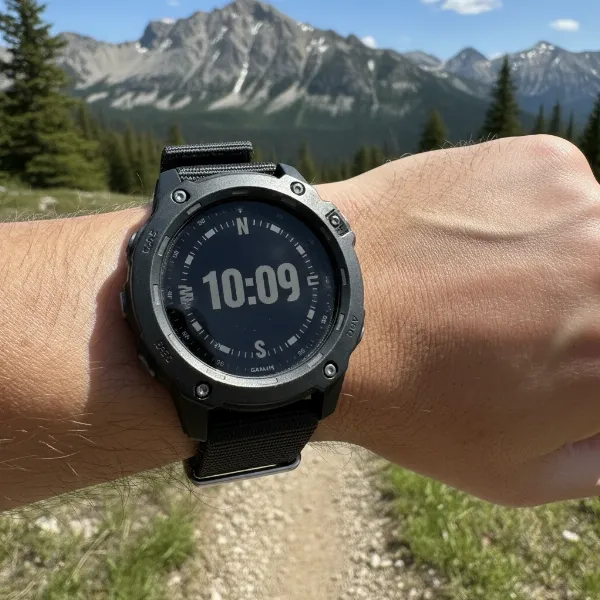
In the ever-evolving world of smartwatches, a distinct category has carved its niche: rugged wearables built to withstand the harshest conditions. If you’re an adventurer, an outdoor enthusiast, or simply someone who demands resilience from their tech, the Amazfit T-Rex 3 emerges as a compelling contender. This latest iteration in the T-Rex series aims to deliver military-grade durability and extensive smart features without the premium price tag often associated with such robust devices. But does it truly strike the right balance between toughness, intelligence, and affordability? Let’s dive deep into what makes the T-Rex 3 a smartwatch worth considering for your next adventure.
Popular Smartwatch Types in the Market
The smartwatch landscape is diverse, catering to a wide range of needs and preferences. Understanding these categories helps contextualize the Amazfit T-Rex 3’s position and appeal.
Sports Smartwatches
Sports smartwatches are engineered for active individuals, focusing on advanced fitness tracking, durable construction, and comprehensive navigation. The Amazfit T-Rex 3 squarely fits into this category, designed to endure challenging environments while monitoring your performance.
- Pros and Cons: These watches typically boast robust build quality, extended battery life, and precise GPS capabilities. However, they can often be bulkier than other types and may have more limited “smart” features compared to lifestyle-oriented smartwatches.
- Key Features: Look for integrated GPS with mapping, a wide array of sport modes, heart rate and blood oxygen monitoring, water resistance, and durable materials like stainless steel and Gorilla Glass. The T-Rex 3 offers these with a bright AMOLED display and extensive activity tracking. It includes a barometric altimeter, gyroscope, and accelerometer.
- Who is it for?: Ideal for hikers, runners, climbers, divers, and anyone who needs a reliable outdoor companion that can track intense physical activity and withstand environmental stressors.
|
Our Picks for the Best Smartwatch in 2026
As an Amazon Associate I earn from qualifying purchases.
|
||
| Num | Product | Action |
|---|---|---|
| 1 | SAMSUNG Galaxy Watch 7 40mm Bluetooth AI Smartwatch w/Energy Score, Wellness Tips, Heart Rate Tracking, Sleep Monitor, Fitness Tracker, 2024, Cream [US Version, 1Yr Manufacturer Warranty] |
![Check SAMSUNG Galaxy Watch 7 40mm Bluetooth AI Smartwatch w/Energy Score, Wellness Tips, Heart Rate Tracking, Sleep Monitor, Fitness Tracker, 2024, Cream [US Version, 1Yr Manufacturer Warranty] on Amazon](https://smartwatchus.com/wp-content/plugins/amazon-tables/assets/images/buy.png)
|
| 2 | Amazfit Bip 6 Smart Watch 46mm, 14 Day Battery, 1.97" AMOLED Display, GPS & Free Maps, AI, Bluetooth Call & Text, Health, Fitness & Sleep Tracker, 140+ Workout Modes, 5 ATM Water-Resistance, Black |
|
| 3 | Smart Watch for Men, 120+ Sports Modes Smartwatch with 1.83" HD Touchsreen, Sleep Monitor, IP67 Waterproof, Bluetooth Call & Music Control Fitness Watch for iPhone/Android Black |
|
| 4 | Apple Watch Series 11 [GPS 42mm] Smartwatch with Rose Gold Aluminum Case with Light Blush Sport Band - S/M. Sleep Score, Fitness Tracker, Health Monitoring, Always-On Display, Water Resistant |
|
| 5 | Smart Watch for Men, 120 Sports Modes Smartwatch with 1.83" HD Touchsreen, IP67 Waterproof, Sleep Monitor, Bluetooth Call & Music Control Fitness Watch for Android/iPhone (Black) |
|
| 6 | WHOOP 5.0/MG Activity Tracker - 12 Month Membership - Health and Fitness Wearable – 24/7 Activity and Sleep Tracker, Personalized Coaching, Menstrual Cycle Insights – 14+ Days Battery Life |
|
| 7 | Smart Watch, 2026 AMOLED 1.43" Fitness Smartwatch for Men Women, Bluetooth 5.4 Call, 130+Sports Modes, 60+Days Flashlight, Heart Rate/Sleep Monitor, IP68 Waterproof Activity Tracker for Android iOS |
|
| 8 | Smart Watch for Men Women Compatible with iPhone Samsung Android Phone 1.83 inch Full Touch Screen IP68 Waterproof Bluetooh Fitness Tracker Heart Rate/Sleep Monitor, Black |
|
| 9 | Apple Watch Series 11 [GPS 46mm] Smartwatch with Jet Black Aluminum Case with Sport Band - M/L. Sleep Score, Fitness Tracker, Health Monitoring, Always-On Display, Water Resistant |
|
| 10 | Smart Watch with Alexa Built-in, 1.83" HD Touchscreen Fitness Tracker with Bluetooth Calling, Fitness Watch with Heart Rate/Sleep Monitor, 120+ Sports Modes, IP68 Waterproof Smartwatch for Android iOS |
|
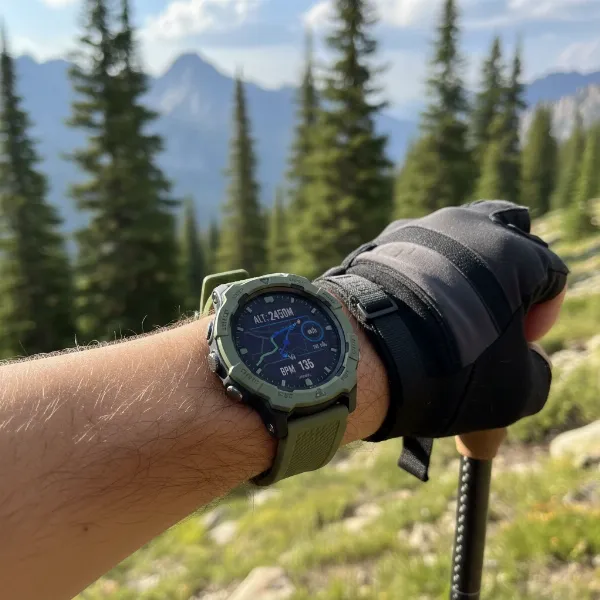 Amazfit T-Rex 3 on a hiker's wrist, showing robust design and outdoor tracking features.
Fashion Smartwatches
Fashion smartwatches prioritize aesthetics, often featuring elegant designs, premium materials, and customizability to complement personal style. Their primary focus is on everyday wear and integrating seamlessly with your daily life.
- Pros and Cons: These watches typically offer a sleek, lightweight design and sophisticated aesthetics, often with a wider range of third-party apps. However, they usually come with shorter battery life and may not offer the same level of ruggedness or advanced fitness tracking as sports-specific models.
- Key Features: Expect vibrant AMOLED screens, customizable watch faces, various strap options, and features like smartphone notifications, mobile payments (NFC), and voice assistants.
- Who is it for?: Best suited for urban professionals, fashion-conscious users, and those who desire a smartwatch that blends style with basic smart functionalities.
Versatile Smartwatches
Versatile smartwatches aim to offer a balanced blend of fitness tracking, smart features, and everyday convenience. They try to be a jack-of-all-trades, suitable for moderate workouts and daily use.
- Pros and Cons: These models offer a good compromise, providing decent fitness tracking alongside essential smart features and a more moderate design. Their battery life usually falls between sports and fashion smartwatches. They might not excel in extreme conditions or offer the deepest app ecosystems.
- Key Features: A combination of health monitoring, diverse workout modes, notification handling, and some form of mobile payment, all within a reasonably durable and stylish package.
- Who is it for?: Great for general users who want a capable all-rounder for casual fitness and daily digital interactions without specializing in either extreme.
Comparing Leading Smartwatch Brands
The market for rugged and feature-rich smartwatches is competitive. Here’s how the Amazfit T-Rex 3 stands against some of the industry’s giants.
Apple Watch Ultra
The Apple Watch Ultra series is Apple’s foray into the rugged smartwatch market, boasting advanced features and premium build quality for extreme sports.
- Pros and Cons: It offers an unparalleled ecosystem integration with iOS, robust health and safety features, and a bright, responsive display. However, its battery life is significantly shorter than the T-Rex 3, and it comes at a considerably higher price point.
- Key Features: Cellular connectivity, advanced diving computer, customizable action button, precision dual-frequency GPS, and extensive health sensors.
- Price: Typically ranges from $799 and up.
Samsung Galaxy Watch Ultra
Samsung’s answer to the high-end rugged wearable, the Galaxy Watch Ultra, offers a blend of style, comprehensive health tracking, and the vast Wear OS ecosystem.
- Pros and Cons: It provides a rich app experience, advanced health monitoring, and a sleek design for a rugged watch. Similar to the Apple Watch Ultra, its battery life is shorter than the T-Rex 3, and it carries a high price.
- Key Features: Wear OS powered by Samsung, BIA sensor for body composition, ECG, blood pressure monitoring, and diverse fitness modes.
- Price: Usually starts around $599-$649.
Garmin
Garmin is a dominant force in the outdoor and fitness smartwatch segment, known for its exceptional GPS accuracy, mapping capabilities, and multi-week battery life, exemplified by models like the Fenix and Instinct series.
- Pros and Cons: Garmin watches are revered for their industry-leading GPS and mapping, extensive sport metrics, and superior battery endurance, often in a rugged package. They can be more expensive than Amazfit and sometimes have less vibrant displays or limited “smart” features outside of fitness.
- Key Features: Multi-GNSS support, advanced topographic mapping, sophisticated performance metrics (VO2 Max, training load), long battery life (especially with solar charging), and military-standard durability.
- Price: Fenix series often starts from $900+, while Instinct series can be found around $200-$450.
Fitbit
Fitbit is primarily known for its fitness trackers and more accessible smartwatches, focusing on daily health and wellness monitoring.
- Pros and Cons: Fitbit devices are user-friendly, excellent for basic health and sleep tracking, and often more affordable. They generally lack the ruggedness, advanced navigation, and extended battery life required for serious outdoor adventures, which the T-Rex 3 offers.
- Key Features: Continuous heart rate tracking, sleep stages, activity tracking, stress management tools, and a focus on overall wellness insights.
- Price: Generally in the $100-$300 range for their smartwatches.
Detailed Comparison Table of Smartwatch Models
To help you visualize the differences, here’s a comparison of the Amazfit T-Rex 3 with its direct predecessors, the T-Rex Ultra and T-Rex 2, alongside a brief look at how it stacks up against a high-end competitor.
| Feature | Amazfit T-Rex 3 | Amazfit T-Rex Ultra | Amazfit T-Rex 2 | Garmin Fenix 8 (AMOLED) |
|---|---|---|---|---|
| Price | ~$279 | ~$399 | ~$229 | ~$999 |
| Dimensions | 48.5 x 48.5 x 13.8mm | 47.3 x 47.3 x 13.45 mm | 47.1 x 47.1 x 13.65 mm | 47 x 47 x 13.8mm |
| Weight | 68g | 89g | 66.5g | 59g |
| Screen Size | 1.5″ AMOLED | 1.39″ AMOLED | 1.39″ AMOLED | 1.4″ AMOLED |
| Max Brightness | 2,000 nits | 1,000 nits | 1,000 nits | 1,000 nits |
| Battery Life (Smartwatch Mode) | Up to 27 days | Up to 20 days | Up to 24 days | Up to 16 days |
| Battery Life (GPS Mode) | 42 hours (standard), 180 hours (max) | 46 hours (GPS only), 28 hours (Dual-band) | 50 hours (GPS only), 26 hours (Dual-band) | 38 hours (standard), 81 hours (max) |
| Durability Standard | Military-grade (MIL-STD-810G), Stainless steel bezel | MIL-STD-810G, 316L Stainless steel | MIL-STD-810G, Polymer alloy | MIL-STD-810G, Sapphire, Titanium |
| Water Resistance | 10 ATM (suitable for freediving to 45m) | 10 ATM (diving cert. to 30m), mud-proof | 10 ATM | 10 ATM |
| GPS | Dual-band, multi-satellite positioning, offline maps | Dual-band, multi-satellite positioning, offline maps | Dual-band, multi-satellite positioning | Multi-GNSS, TopoActive maps, SatIQ |
| Sports Modes | 170+ | 162 (with diving modes) | 158 | 100+ |
| Smart Features | AI voice assistant, speech-to-text replies, notifications, Zepp Pay (limited) | AI Zepp Coach, Wi-Fi downloads, offline music | Notifications | Garmin Pay, Music, Notifications |
Note: Information for Amazfit T-Rex 3 is based on early reviews and product listings. Features and specifications may vary by region or final release.
Guide to Choosing the Right Smartwatch
Selecting a smartwatch involves more than just picking the latest model. It’s about aligning its capabilities with your lifestyle.
Determine Usage Needs
Consider what you’ll primarily use the smartwatch for. Are you a hardcore adventurer, a casual fitness enthusiast, or more interested in daily notifications and style?
- For extreme outdoor activities: The Amazfit T-Rex 3, with its military-grade durability, impressive battery life, and offline mapping, is designed for the rigors of the wild. Features like extreme temperature resistance (158F heat to -22F cold) and 10 ATM water resistance for diving make it highly suitable.
- For daily fitness and tracking: Most smartwatches offer basic step, calorie, and heart rate tracking. The T-Rex 3 provides comprehensive health and fitness metrics including VO2 max, training load, recovery time, and a Readiness score.
- For smart features and connectivity: If mobile payments, extensive third-party apps, and seamless phone integration are paramount, consider options beyond the T-Rex 3, which, while improving, still has more limited smart features compared to Wear OS or watchOS devices.
Budget
Your budget will significantly influence your choices. High-end rugged smartwatches can cost upward of $800-$1000, while more budget-friendly options like the T-Rex 3 offer a compelling alternative around $250-$300. The T-Rex 3 provides an excellent value proposition, delivering many premium features at a fraction of the cost of its rivals.
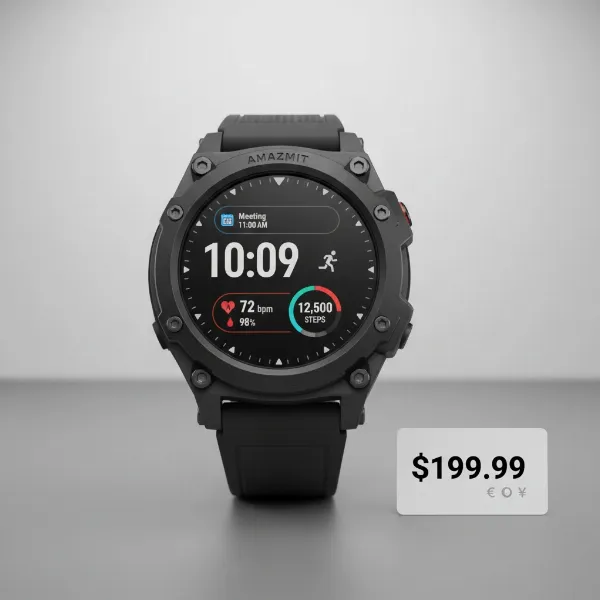 Amazfit T-Rex 3 showcasing its AMOLED display with key health and fitness metrics.
Brand and Model
Research different brands to understand their ecosystems and design philosophies. Amazfit’s T-Rex series, including the T-Rex 3, is known for its ruggedness and value. Garmin excels in professional-grade outdoor tracking. Apple and Samsung lead in integrated smart features.
- Should you choose Amazfit T-Rex 3? If you seek a durable, long-lasting smartwatch with accurate GPS and extensive fitness tracking for outdoor adventures, and you appreciate a strong value, the T-Rex 3 is an excellent choice. Its large AMOLED display and offline maps are standout features.
- Consider other models if: You need highly dynamic running metrics (like those from Garmin), a vast third-party app ecosystem, or a more compact and lighter design for small wrists. Some users have found the T-Rex 3 to be bulky and uncomfortable for extended wear.
Other Factors
- Size: The T-Rex 3 is a large watch, measuring 48.5mm, which might be substantial for those with smaller wrists. Consider trying it on if possible.
- Battery Life: The T-Rex 3 truly shines here, offering up to 27 days in smartwatch mode and 42 hours with accurate GPS. This makes it ideal for multi-day trips where charging isn’t an option.
- Water Resistance: With a 10 ATM rating, the T-Rex 3 is suitable for swimming, snorkeling, and even freediving to a depth of 45 meters, making it a versatile companion for water sports.
- Operating System: The T-Rex 3 runs on Zepp OS, which is functional and feature-packed but may not be as polished or offer the same third-party app breadth as Wear OS or watchOS. While it includes a voice-activated AI assistant and speech-to-text message replies, traditional smartwatch features are more limited, and NFC for mobile payments (Zepp Pay) has regional limitations.
“The Amazfit T-Rex 3 is an affordable, rugged smartwatch that punches well above its weight, offering impressive features and capabilities typically found in far pricier models.”
Conclusion
The Amazfit T-Rex 3 carves out a robust identity in the competitive smartwatch market, particularly for those prioritizing military-grade durability and an exceptional blend of outdoor adventure features with outstanding battery life. It stands as a testament to Amazfit’s commitment to delivering high-performance wearables at a fraction of the cost of its premium competitors. While its smart features may not rival the extensive ecosystems of Apple or Samsung, the T-Rex 3 excels in its core purpose: being a reliable, tough companion for the most demanding environments and fitness pursuits. Its vibrant AMOLED display, accurate GPS with offline maps, and extensive activity modes make it a compelling choice for adventurers and budget-conscious athletes alike.
Ultimately, if you’re seeking a smartwatch that can truly unleash your instinct for adventure without breaking the bank, the Amazfit T-Rex 3 deserves a spot on your wrist. Are you ready to embrace its unyielding durability for your next challenge?
Frequently Asked Questions
What makes the Amazfit T-Rex 3 “military-grade durable”?
The Amazfit T-Rex 3 is built to military-grade standards (MIL-STD-810G), featuring a 316L stainless steel bezel and a polymer case. It’s designed to withstand extreme temperatures from 158°F heat to -22°F cold and boasts 10 ATM water resistance, suitable for surfing and freediving.
How long does the Amazfit T-Rex 3’s battery last with GPS?
The Amazfit T-Rex 3 offers impressive battery longevity, providing up to 42 hours in accurate GPS mode and an extended 180 hours in maximum battery GPS mode. In typical smartwatch use, it can last for up to 27 days on a single charge, making it ideal for extended adventures.
Does the Amazfit T-Rex 3 support offline maps?
Yes, the Amazfit T-Rex 3 supports free offline topographic maps with turn-by-turn navigation. These maps need to be downloaded via the Zepp app and synced to the watch, providing essential navigation tools even without cellular connectivity.
Can I make contactless payments with the Amazfit T-Rex 3?
The Amazfit T-Rex 3 does support contactless payments via Zepp Pay. However, it requires a Curve card and may not be available in all countries, which can limit its practicality for some users.
Is the Amazfit T-Rex 3 comfortable for daily wear?
While opinions vary, some reviewers find the Amazfit T-Rex 3, with its large 48.5mm case and 68g weight, to be bulky. However, others note that its contoured design and high-quality silicone strap make it surprisingly wearable and less cumbersome than some comparable rugged watches.